
What Makes a Kids App Truly Safe?
In March 2026, two juries in two states did something courts had never done before. They held Big Tech legally accountable for harming children.
A California jury found Meta and YouTube liable for designing platforms that rely on algorithms to keep children watching and scrolling for as long as possible. A New Mexico jury ordered Meta to pay $375 million for failing to protect young users from exploitation. More than 1,500 similar cases are pending across the country.
Parents already knew something was wrong. The courts made it undeniable.
But here is the question that matters most:
Why were these platforms harmful in the first place?
Because millions of children were using systems designed to keep them continuously engaged.
⸻
The Business Model Is the Problem
YouTube and Instagram were not designed to educate children. They were designed to keep users watching, scrolling, and returning as often as possible.
That design is driven by advertising.
Algorithms are the engine behind this system. They are not neutral. They are designed to study behavior, track what a child watches, and continuously serve more of the same content to keep them engaged.
If a child watches one type of video, the algorithm feeds them more of it. If they pause longer on something, it sends more similar content. Over time, the system learns what holds their attention and keeps reinforcing it.
There is no natural stopping point.
Children are especially vulnerable to this.
Their brains are still developing. Their ability to regulate time and attention is still forming. Yet these systems are designed to remove friction, encourage repetition, and keep them engaged for as long as possible.
This is not accidental. It is how the system is built to work.
When attention drives revenue, engagement becomes the priority.
⸻
What It Means to Build Differently
Kid’s Portal was built from the start with a different model: subscriptions, not advertising.
That choice changes everything.
When a platform depends on advertising, its goal is to keep users engaged for as long as possible. That’s where algorithms come in. They learn what holds attention and serve more of it, creating a loop that keeps children watching, clicking, and scrolling.
When a platform is supported by subscriptions, that pressure disappears.
There is no need to maximize time-on-platform. No need to study behavior to keep a child hooked. No reason to design features that pull them back in.
Kid’s Portal does not use recommendation algorithms.
What a child sees is not shaped by behavioral data or automated feeds. There is no endless stream of content being pushed at them.
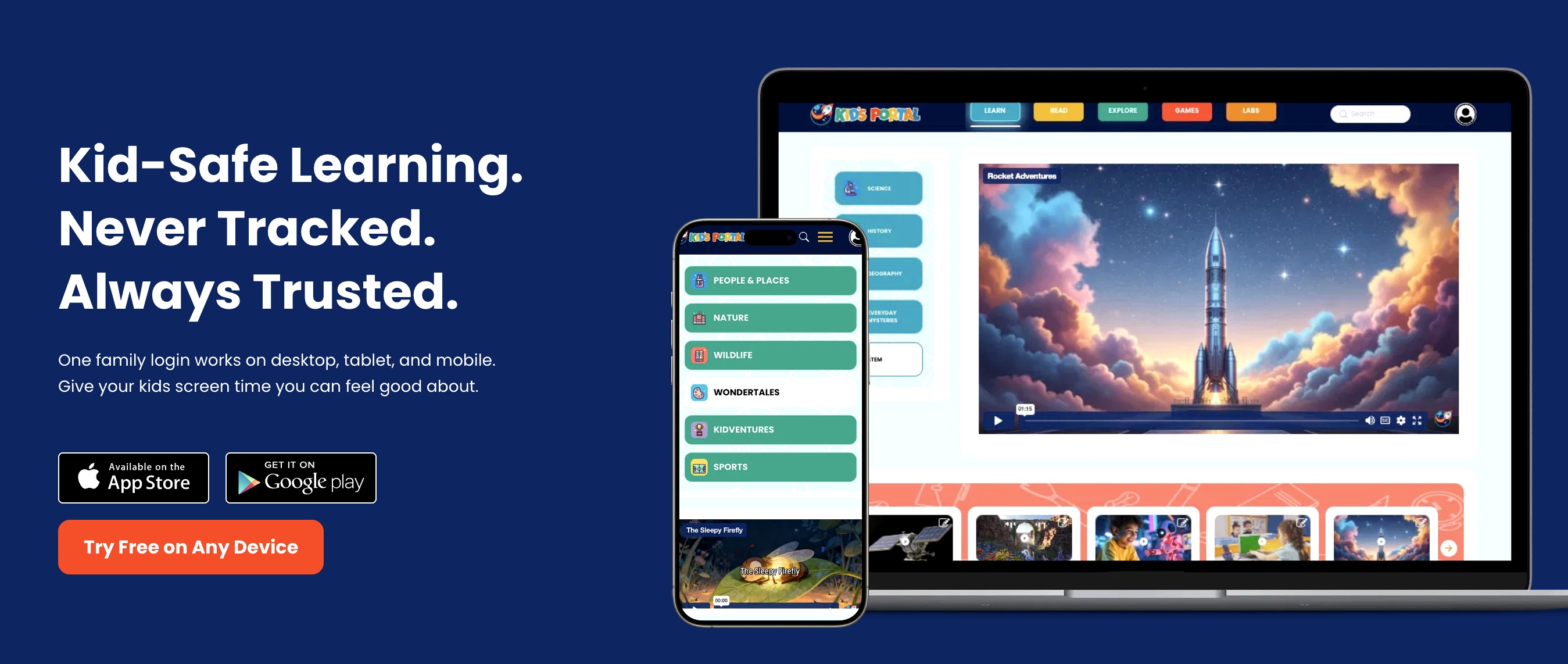
Instead, it is structured as an educational environment with videos, interactive games, storybooks, and printable activities across subjects like science, history, geography, and reading.
The experience is simple for kids to navigate and built around exploration, without systems pushing them toward more content.
There are no ads. No tracking. No external links.
A child can move through the platform without being redirected, profiled, or influenced by systems designed to keep them engaged.
⸻
Not a Reaction. A Foundation.
Kid’s Portal was not created in response to lawsuits or regulation.
These decisions were there from the beginning.
It started with a simple observation. Many platforms marketed to children were still built on the same underlying system: algorithms, advertising, and engagement-driven design.
Even when labeled educational, the structure remained the same.
That exposed a clear gap.
There was no single place where parents could find educational content, games, and reading in one environment without ads, tracking, or algorithms shaping what a child sees.
So it was built from scratch.
Kid’s Portal includes educational videos, games, storybooks, and printable activities across science, history, geography, nature, reading, and more.
No ads. No tracking. No algorithms.
Just content worth paying for.
⸻
The Verdicts Change the Conversation
The recent court decisions matter beyond the companies involved.
They reflect a broader shift in how digital platforms are being evaluated when it comes to children.
For years, platforms pointed to safety features and parental controls. But those features exist within systems still driven by algorithms designed to maximize engagement.
That is the part that is now being questioned.
Parents are paying closer attention. Regulators are responding. The conversation is changing.
But families do not have to wait for laws or lawsuits to make different choices.
⸻
A Different Choice Is Available
Kid’s Portal is available on the App Store, Google Play, and online.
It brings together educational videos, games, storybooks, and printable activities in one safe environment.
No ads. No tracking. No algorithms.
One subscription for the family. One login across supported devices.
Try it free for 3 days →kidsportal.co