
For years, schools invested heavily in laptops and tablets. During the pandemic, those devices became essential for learning.
Now, many educators are asking whether technology has become too central to the classroom.
LAUSD’s answer is to reduce screen time.
That will likely help in some situations.
But reducing screen time alone doesn’t guarantee better learning.
The better question is:
What are children doing while they’re on a screen?
Twenty minutes of reading an interactive story, exploring the solar system, or learning about wildlife is fundamentally different from twenty minutes of passive entertainment or endless recommended videos.
Both involve screens.
Only one was designed to educate.
When we treat all screen time as equal, we risk overlooking the difference between purposeful learning and passive consumption.
LAUSD’s new policy recognizes that technology should serve learning, not distract from it.
That’s an important shift.
But limiting minutes is only one part of the equation.
Quality matters just as much.
Parents and educators should also ask:
Those questions determine whether technology supports curiosity or competes for attention.
One unintended benefit of LAUSD’s policy is that it raises the value of every minute children spend on a device.
If students have only a limited amount of screen time during the school day, and many families also set limits at home, those minutes become more meaningful.
That makes choosing high-quality educational experiences even more important.
The goal shouldn’t simply be less technology.
It should be better technology.
Technology that encourages exploration.
Technology that teaches.
Technology designed around children instead of engagement metrics.
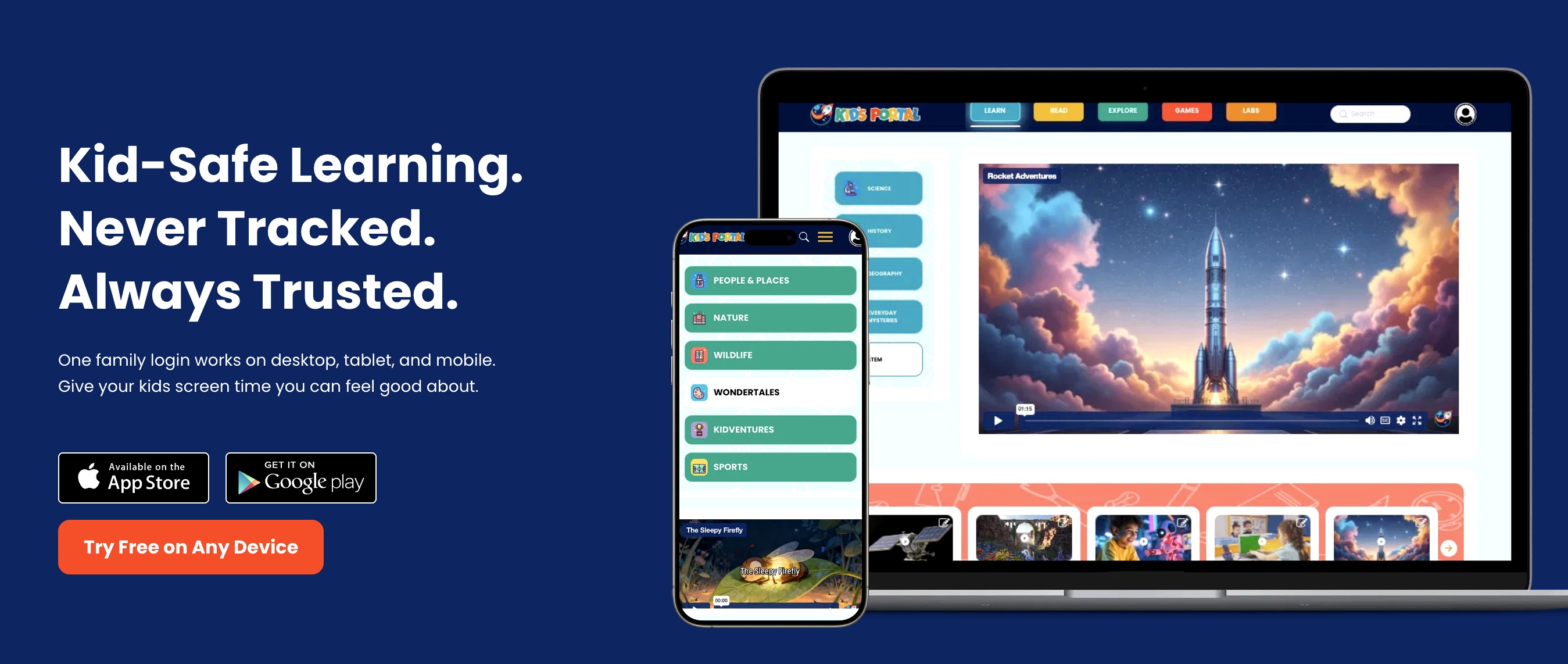
Kid’s Portal was built around this philosophy.
Instead of maximizing screen time, it focuses on maximizing learning.
Designed for children ages 5–10, Kid’s Portal offers educational videos, interactive games, storybooks, and printable activities covering science, wildlife, geography, history, nature, reading, and STEM.
There are no ads.
No behavioral tracking.
No recommendation algorithms deciding what comes next.
Children simply explore a curated library of age-appropriate content at their own pace.
LAUSD’s decision signals something much larger than a new classroom policy.
It reflects a broader shift in how parents, educators, and schools think about children’s technology.
The future isn’t choosing between screens and no screens.
The future is choosing better digital experiences.
Because when screen time is limited, every minute should be worth it.
Kid’s Portal is an ad-free educational platform for children ages 5–10 featuring educational videos, games, storybooks, and printable activities.
Available on the App Store, Google Play, and at app.kidsportal.co.
Try it free for 3 days.